Sourdough Baguette

Updated: Oct 9
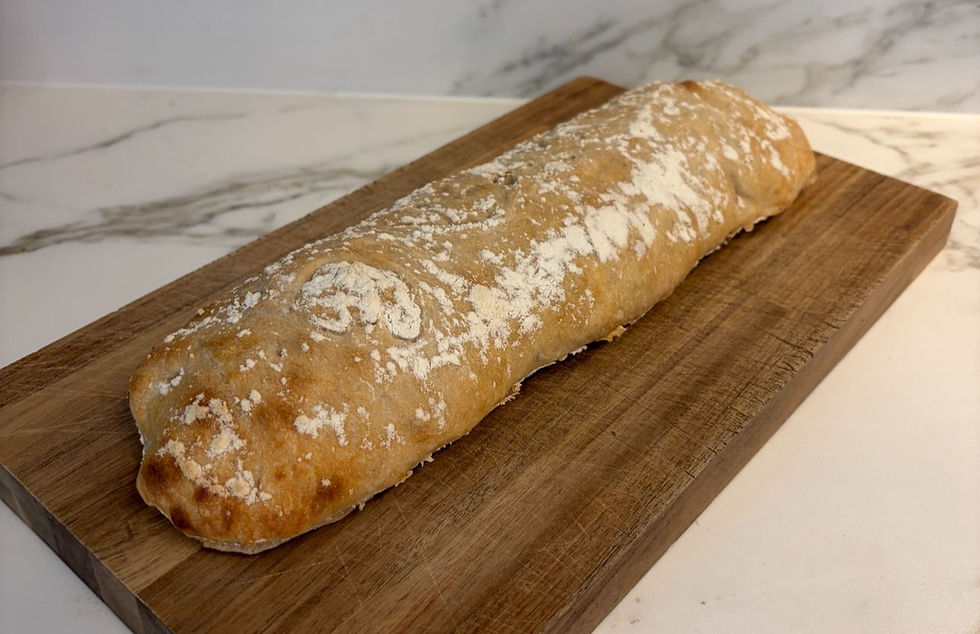
Sourdough baguette combines traditional French shaping with the flavor and fermentation benefits of natural sourdough. Compared to a standard country loaf, baguettes require a dough that balances strength and extensibility so it can expand during baking while maintaining its long, slender shape.
After testing this formula with both bread flour and French-style T65 flour, I consistently obtained the best crust texture and crumb structure with T65. The flour provides enough strength for oven spring while keeping the interior open and light. When properly fermented and shaped, the result is a baguette with a thin crackling crust, irregular airy crumb, and deeper flavor than a typical yeast-based baguette.
To bake great sourdough at home, everything starts with a healthy and active starter. A strong starter helps produce reliable fermentation and good oven spring. If you are still building your foundation, it helps to understand the basics of sourdough baking through sourdough bread basics, where the full process is explained step by step.
Sourdough baguette is one of the most popular recipes within sourdough dough variations. While pizza, focaccia, and ciabatta use similar fermentation principles, baguettes create a completely different texture and baking experience from the same core ingredients.

Sourdough Baguette and Dough Development
Baguette dough depends heavily on proper dough development. Unlike pizza dough, which prioritizes extensibility, a baguette needs enough strength to maintain its shape while still expanding efficiently in the oven. T65 flour works exceptionally well for baguettes because it creates a balance between elasticity and extensibility. This allows the dough to expand while remaining structured throughout fermentation and baking.
Proper fermentation remains one of the most important factors in achieving a crisp crust and light interior.
Prep time: 25 minutes · Fermentation: 8–12 hours · Bake time: 20–25 minutes · Total: 9–13 hours
Why This Sourdough Baguette Works
This formula focuses on balancing dough strength, fermentation activity, and shaping technique to create a baguette with strong oven spring, a crisp crust, and an open crumb structure.
Ingredients for Sourdough Baguette
These ingredients create two medium sourdough baguettes.
500 g T65 flour (about 4 cups)
350 g lukewarm water (about 1⅓ cups)
100 g active sourdough starter (about ½ cup)
7 g salt (about 1 tsp)
The relatively simple ingredient list allows fermentation and flour quality to play the leading role in the final flavor.
Equipment Needed
While professional baguette equipment can help, it is not required.
large mixing bowl
dough scraper
baking tray or baking stone
parchment paper
clean kitchen towel
sharp knife or lame
These tools help simplify handling and improve consistency throughout the process. A baking stone or baking steel can improve heat transfer and oven spring, but excellent sourdough baguettes can also be baked successfully on a preheated baking tray. Steam during the first stage of baking is often more important than specialized equipment.
How to Make Sourdough Baguette
This step‑by‑step method focuses on achieving structure, flavor, and a classic baguette shape.
Step 1: Mix the dough
In a large bowl, combine the lukewarm water (350 g or about 1⅓ cups) and active sourdough starter (100 g or about ½ cup). Add the T65 flour (500 g or about 4 cups) and salt (7 g or about 1 tsp). Mix until a rough dough forms.
Step 2: Initial rest
Allow the dough to rest for 30 minutes. This helps the flour absorb water and improves dough development during folding.
Step 3: Build strength
Perform three to four sets of stretch‑and‑folds over the next two hours. The dough should become smoother, stronger, and easier to handle after each set.
Step 4: Bulk fermentation
Cover the dough and allow it to ferment until it gains noticeable volume and strength.
If the dough struggles to develop properly, you can review dense sourdough fixes to better understand common structural problems. A more reliable indicator than time alone is dough expansion. In a typical kitchen environment around 21 to 24°C (70 to 75°F), the dough is usually ready when it has expanded by roughly 50% and shows visible fermentation bubbles. Under-fermented dough often produces dense baguettes, while over-fermented dough tends to spread during shaping and baking.
Step 5: Divide and pre-shape
Transfer the dough onto a lightly floured surface. Divide it into two equal portions and shape each portion into a loose cylinder. Allow the dough to rest briefly before final shaping.
Step 6: Shape the baguettes
Gently shape each portion into a long baguette shape. The goal is to create tension while keeping as much internal air as possible inside the dough.
Step 7: Final rest
Place the shaped baguettes on parchment paper or a floured towel and allow them to rest until noticeably lighter and slightly expanded.
Step 8: Score and bake
Preheat the oven to 240 °C (465 °F). Score the baguettes with several shallow cuts and bake for approximately 20–25 minutes until deeply golden and crisp. For the best oven spring, score each baguette at a shallow angle of approximately 30 degrees. Deep vertical cuts often prevent the classic baguette ear from forming and can reduce expansion during baking.

Sourdough Baguette vs Standard Sourdough Bread
Both recipes use similar ingredients, but the final result is very different.
Feature | Sourdough Baguette | Standard Sourdough Bread |
Shape | Long and slender | Round or oval |
Crust | Thin and crisp | Thicker |
Crumb | Open and airy | More varied |
Baking time | Shorter | Longer |
Handling | More shaping required | Less shaping required |
The biggest difference is the crust-to-crumb ratio. Baguettes provide more crust in every bite.
Texture and Flavor
A well-made sourdough baguette develops a thin, crisp crust that cracks slightly when sliced. Inside, the crumb remains light, airy, and pleasantly chewy. Natural fermentation adds subtle tangy notes without overwhelming the wheat flavor. The result is a baguette that feels delicate yet flavorful, making it suitable for both everyday meals and special occasions.
When Sourdough Baguette Goes Wrong
If the baguettes spread out rather than rising upward, the dough may not have developed enough strength. If the dough struggles to rise during fermentation, reviewing why sourdough doesn’t rise can help identify the underlying cause.
Most baguette problems result from insufficient dough strength or weak starter activity.
Nutritional Information
This nutritional estimate reflects one quarter of a baguette.
Nutrient | Amount per Serving |
Calories | 210 kcal |
Total Carbohydrates | 41 g |
Fiber | 1.8 g |
Sugars | 0.8 g |
Protein | 7 g |
Total Fat | 0.8 g |
Saturated Fat | 0.1 g |
Salt | 0.7 g |
Sodium | 280 mg |
Sourdough baguette demonstrates how the same fermentation principles used in traditional sourdough bread can create an entirely different eating experience. By focusing on dough strength, shaping, and baking control, you can create a crisp and flavorful baguette at home.
While sourdough baguettes require more shaping precision than many other sourdough breads, the reward is a uniquely crisp crust and airy crumb. Mastering fermentation, dough strength, and shaping technique will dramatically improve consistency and help produce bakery-style results at home. If you enjoy experimenting with naturally fermented dough, these sourdough hamburger buns showcase how similar techniques can produce a softer crumb and an entirely different eating experience.
Frequently Asked Questions
Find answers to common sourdough baguette questions about fermentation, flour selection, dough strength, and achieving an airy crumb with a crisp crust.
Why is my sourdough baguette flat?
Flat sourdough baguettes are usually the result of insufficient gluten development, over-proofing, or a weak starter. The dough should feel strong and hold tension after shaping. A healthy starter and proper fermentation help create better oven spring and a taller baguette.
Can I use bread flour instead of T65 flour?
Yes. Bread flour works well and is often easier to find than T65 flour. While T65 is commonly used for traditional French baguettes, bread flour can still produce excellent crust, crumb structure, and flavor when fermented properly.
Why didn't my baguette develop an open crumb?
An open crumb depends on strong fermentation, good gluten development, and careful shaping. Under-fermented dough often produces a dense interior, while rough handling during shaping can remove the gas pockets needed for a lighter crumb.
How do I know when bulk fermentation is finished?
The dough should appear noticeably puffier, contain visible air bubbles, and increase by roughly 50% in volume. Fermentation times vary depending on temperature, so the condition of the dough is usually a better indicator than the clock.
Why didn't my baguette get a crispy crust?
A pale or soft crust is often caused by insufficient baking time, low oven temperature, or lack of steam during baking. Proper steam and a fully preheated oven help create the thin, crisp crust associated with a traditional baguette.
Can I refrigerate sourdough baguette dough overnight?
Yes. Cold fermentation slows yeast activity and often improves flavor development. Many bakers refrigerate the dough overnight before shaping or baking to create a deeper sourdough flavor and a more flexible baking schedule.


Comments